Wednesday, 27 April 2016

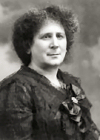
Hertha Marks Ayrton

Hertha Marks Ayrton

Hertha Ayrton
April 28, 1854 - August 23, 1923

Phoebe Sarah Marks was born in Portsea, England in 1854. She changed her first name to Hertha when she was a teenager. After passing the Cambridge University Examination for Women with honors in English and mathematics, she attended Girton College at Cambridge University, the first residential college for women in England. Charlotte Scott also attended Girton at this time, and she and Marks helped form a mathematics club to "find problems for the club to solve and 'discuss any mathematical question that may arise'" [1]. Marks passed the Mathematical Tripos in 1880, although with a disappointing Third Class performance. Because Cambridge did not confer degrees to women at this time, just certificates, she successfully completed an external examination and received a B.Sc. degree from the University of London.
From 1881 to 1883, Marks worked as a private mathematics tutor, as well as tutoring other subjects. In 1884 she invented a draftsman's device that could be used for dividing up a line into equal parts as well as for enlarging and reducing figures. She was also active in devising and solving mathematical problems, many of which were published in the Mathematical Questions and Their Solutions from the "Educational Times". Tattersall and McMurran write that "Her many solutions indicate without a doubt that she possessed remarkable geometric insight and was quite a clever student of mathematics."
Marks began her scientific studies by attending evening classes in physics at Finsbury Technical College given by Professor William Ayrton, whom she married in 1885. She assisted her husband with his experiments in physics and electricity, becoming an acknowledged expert on the subject of the electric arc. She published several papers from her own research in electric arcs in the Proceedings of the Royal Society of London and The Electrician, and published the book The Electric Arcin 1902. According to Tattersall and McMurran,
The text included descriptions and many illustrations of her experiments, succinct chapter reviews, a comprehensive index, an extensive bibliography, and a chapter devoted to tracing the history of the electric arc. Her historical account provided detailed explanations of previous experiments and results involving the arc and concluded with the most recent research of the author and her colleagues...The book was widely accepted as tour de force on the electrical arc and received favorable reviews on the continent where a German journal enthusiastically praised if for its clear exposition and relevant conclusions.
Hertha Ayrton had been elected the first female member of the Institution of Electrical Engineers in 1899. In 1902 she became the first woman nominated a Fellow of the Royal Society of London. Because she was married, however, legal counsel advised that the charter of the Royal Society did not allow the Society to elect her to this distinction (this advice was reversed in 1923, but the first woman was still not admitted to the Royal Society until twenty years later.) However, in 1904 Ayrton did become the first woman to read her own paper before the Royal Society. This paper was on "The origin and growth of ripple-mark" [Abstract] and was later published in the Proceedings of the Royal Society. In 1906 Ayrton received the Royal Society's Hughes Medal for her experimental investigations on the electric arc, and also on sand ripples. She was the fifth recipient of this prize, award annually since 1902 in recognition of an original discovery in the physical sciences, particularly electricity and magnetism or their applications, and as of 2011, one of only two women so honored. (The award is now given for original discovery in the physical sciences, particularly as applied to the generation, storage and use of energy.)
After her husband's death in 1908, Ayrton continued her research. One set of experiments validated Lord Rayleigh's mathematical theory of vortices. She also invented a fan that could create spiral vortices to repel gas attacks. These became known as Ayrton fans, but were never widely used.
Ayrton was an active member of the Woman's Social and Political Union and participated in many suffrage rallies between 1906 and 1913. She was a founding member of the International Federation of University Women and the National Union of Scientific Workers. She served as vice-president of the British Federation of University Women and vice-president of the National Union of Women's Suffrages Societies. Two years after her death in 1923, her lifelong friend Ottilie Hancock endowed the Hertha Ayrton Research Fellowship at Girton College.
Selected Publications
  1. The Mechanism of the Electric Arc, Philosophical Transactions of the Royal Society of London. Series A, Containing Papers of a Mathematical or Physical Character, Vol. 199, (1902), pp. 299-336 [JSTOR]
  2. On the Non-Periodic or Residual Motion of Water Moving in Stationary Waves, Proceedings of the Royal Society of London. Series A, Containing Papers of a Mathematical and Physical Character, Vol. 80, No. 538 (Apr. 6, 1908), pp. 252-260 [JSTOR]
  3. The Origin and Growth of Ripple-Mark, Proceedings of the Royal Society of London. Series A, Containing Papers of a Mathematical and Physical Character, Vol. 84, No. 571 (Oct. 21, 1910), pp. 285-310 [JSTOR]
  4. Local Differences of Pressure Near an Obstacle in Oscillating Water, Source: Proceedings of the Royal Society of London. Series A, Containing Papers of a Mathematical and Physical Character, Vol. 91, No. 631 (Jul. 1, 1915), pp. 405-410 [JSTOR]
  5. On a New Method of Driving off Poisonous Gases, Source: Proceedings of the Royal Society of London. Series A, Containing Papers of a Mathematical and Physical Character, Vol. 96, No. 676 (Oct. 9, 1919), pp. 249-256 [JSTOR]

References

  1. James Tattersall and Shawnee McMurran. "Hertha Ayrton: A Persistent Experimenter," Journal of Women's History, Vol. 7, No., 2 (Summer 1995), 86-112.
  2. Biography at the Institute of Electrical Engineers Archives
  3. Malley, Marjorie. "Hertha Marks Ayrton," Women in Chemistry and Physics, L.S. Grinstein, Rose K. Rose, and M. H. Rafailovich, Editors, Greenwood Press, 1993. Available online at Contributions of Women in Physics, UCLA.
  4. Reminiscences by A. P. Trotter, (past) President of The Institute of Electrical Engineers
  5. Mason, Joan. "Hertha Ayrton (1854--1923) and the admission of women to the Royal Society of London," Notes and Records Roy. Soc. London 45 (1991), no. 2, 201--220
Photo Credit: Photograph is used with the permission of the Institute of Electrical Engineers (IEE) Archives

Review: 'Captain America: Civil War' Shows the Best and Worst of Marvel Movies

"Captain America: Civil War" isn't necessarily the best Marvel movie — directing duo Joe and Anthony Russo fail to deliver even a fraction of the scale, grace, and ineffable sense of joy that Joss Whedon brought to "The Avengers" — but it's nevertheless the Platonic ideal of a Marvel movie.  
More so than any of the previous episodes in the Marvel Cinematic Universe, "Civil War" is a soap opera in spandex. In part, that's because of the film's refreshing (if not fully realized) emphasis on emotional turmoil rather than global destruction; while plenty of buildings blow up, most of the collateral damage is caused by the good guys as they argue with each other and threaten to go their separate ways. This isn't just about killing time before the Infinity Wars, it's about fulfilling the ultimate goal of the MCU: A film franchise so immense and self-perpetuating that a plot's greatest possible conflict is no longer the end of the world, but rather the end of the brand.
Captain America: Civil War
The story begins, as most Marvel movies do, wherever the hell it wants. The profound sense of guilt that began to fester inside Tony Stark (still Robert Downey, Jr.) after the attacks on New York City has been intensified by the death toll from the fight against Ultron in Sokovia. And Stark isn't the only one who's afraid to look in the mirror. Early in the film, Scarlet Witch (Elizabeth Olsen) is devastated when a brawl in Lagos claims a handful of innocent bystanders. With various world governments on edge about the continued existence of the Avengers — whose formation seems to have invited a never-ending series of calamities upon the Earth —  U.S. Secretary of State Thaddeus "Thunderbolt" Ross (William Hurt) draws up the Sokovia Accords, which would essentially put the superhero task force under the command of the United Nations. 
"Civil War" is a soap opera in spandex.
Stark, an Oppenheimer type who's desperate to share the burden of guilt, is ready to sign. Steve Rogers (Chris Evans), a product of WWII who believes that the Avengers are capable of policing the planet on their own, is not. Stark thinks that they need regulations; Rogers thinks that they are the regulations. While the MCU is largely inspired by story arcs that were drawn long before the 21st Century, these movies have nevertheless used 9/11 as their north star, and "Civil War" is a natural choice of narratives for a saga that's so preoccupied with the United States' evolving role on the world stage.
The philosophical differences between the two Avengers are enflamed when a bomb detonates during the signing of the Accords, killing the king of Wakanda (a fictional African nation). All signs point to Bucky Barnes as the culprit, but Rogers refuses to believe that his old pal is capable of such evil.
Captain America: Civil War
The villain is clear from the start, and he's far more innocuous than you might think. In fact, for the first time in a Marvel movie, the main antagonist is justsome dude. Sure, he's hatched from comic book mythos, but he doesn't have a super-suit or electric whips or a menacing red face — his name is Helmut Zemo, and he's pretty much just Daniel Brühl. Zemo's most ominous characteristics are his German accent and his penchant for eating bacon — and only bacon — for breakfast. He could just as easily be the villain from a mid-'90s thriller starring Clint Eastwood. His scheme is to agitate the Avengers into fighting each other, and it works. 
Stomping on the carcass of its competition can only get a film so far, but it goes without saying that the rift between these two superheroes is considerably more nuanced and better-developed than that between Batman and Superman. Iron Man and Captain America have some serious shit to work out, and their disagreements aren't resolved out of convenience or in order to rally together against a common foe. In fact, the Russo brothers are so invested in the ideas that bond their characters together (and tear them apart) that Zemo becomes an afterthought, the most forgettable villain in a franchise whose antagonists include Dark Elves and several different bald white men.
What makes "Civil War" so emblematic of the MCU is that it cuts to the heart of what the brand is all about: humanity. "Spider-Man 2" predates the dawn of the MCU, but these movies have never forgotten that film's bittersweet parting thought: Compassion is both our greatest strength, and our greatest liability.
On the flip-side of that coin, ideology is the MCU's most consistent foil (hence the series' dramatically stultifying preoccupation with mind-control, which reaches a painful nadir in "Civil War").  The tension between the potential generosity of strength and the corruptive nature of power also explains why so many of the jokes in these movies — and almost all of the unfunny ones in "Civil War" — boil down to "Superheroes: they're just like us!" So far as Marvel is concerned, they are and always will be. 
Civil War
Rogers and Stark are two sticks of old dynamite wrapped around a single fuse, and all Zemo has to do is light a match. He recognizes that the Avengers' individual guilt is pushing them towards the blind comforts of ideology, just as he recognizes that ideology never leaves much wiggle room. As Rogers puts it: "Compromise where you can. And where you can't, don't."
"Civil War," bursting with fun characters and drawing from a rich mythology, is also the most convincing proof yet that the MCU can compromise just about everywhere. For Marvel, a studio that essentially uses the same score on every movie and fired Edgar Wright from "Ant-Man" because his creative vision deviated from party lines, compromise has become an aesthetic unto itself.
That's never been more evident than it is in "Civil War," especially during the fight scenes. Marvel has always excelled at expressing character through action, and so it stands to reason that the characters suffer if the action becomes less expressive. The combat in "Civil War" is so clumsy that it actually undercuts the drama. The justification behind many of the film's tiffs are hard to believe as it is, but only when the characters actually drop the gloves does it get hard to remember why they're fighting.
Watching "Civil War," it's easy to understand why the MCU is so hung up on the fight in New York — it's the franchise's only great action sequence. Joss Whedon's visceral understanding of cinematic geometry and his symphonic flair for choreographing movement allowed that marquee set-piece to galvanize the separate threads of the Marvel Cinematic Universe into a unified whole. On the contrary, every action beat in "Civil War" is such a discrete hodgepodge of close-ups and medium shots that they might as well exist in a vacuum — at times, this feels like the first movie ever made entirely out of gifs. The problem becomes gallingly clear during a battle royale in which more than a dozen different superheroes square off on an airport tarmac. 
Captain America: Civil War
Not only does the flabbergasting lack of wide shots completely diminish the scale of the fight — it's like the Russo brothers forgot half of their lenses at homes — but it also limits the action to one plane at a time. It doesn't help that the factions feel so arbitrarily determined. Ant-Man (Paul Rudd) gets to have a handful of great moments, but not even he seems to know why he's trying to make life difficult for Tony Stark.
On the other hand, it makes perfect sense that teenage Spider-Man (Tom Holland) is so endearingly overeager just to be there. But the Russo brothers can't juggle two slivers of parallel action — 100% of their attention is focused on the foreground at all times — let alone smoothly re-introduce an iconic Marvel character in the middle of a massive brawl. Holland's precocious zip makes him a wonderful Spidey, just as Chadwick Boseman's stoic strength suggests that his Black Panther will have no trouble carrying his own movie, but just because these new characters feel right in this world doesn't mean that they're provided a proper place in this movie. When the action cuts to either one of them, Captain America and Iron Man suddenly feel a million miles away, and "Civil War" dissolves into nothing more than an advertisement for the MCU's next round of spin-offs. There's no room for context in these shots, just bodies.
It's hard to believe that Tony Stark is being eaten up by something that happened in a different movie if you can't connect two things that happen in the same scene. It's all just empty talk, and "Civil War" becomes a civic lesson that's punctuated by one-liners and explosions. The bigger these movies become, the smaller they feel. The more aggressively they reach for greatness, the more clearly they prove that its beyond their grasp. Marvel movies don't get much better than this. The trouble is, they don't want to.

Hertha Marks Ayrton: The English pioneer who blazed a trail for women in science

Hertha Marks Ayrton’s 162nd birthday

Who was Hertha Marks Ayrton?
Hertha Marks Ayrton was an award-winning English engineer, mathematician, inventor and physicist,  best known for her ground-breaking work on electric arcs and sand ripples.
Born in Portsea, Portsmouth, on April 28, 1854, she was of Jewish parentage and the third of eight children. She was the daughter of a seamstress, while her father was a clockmaker and jeweller who left his family in debt when he passed away in 1861.
She went to live in London at the age of nine and was taught at a school owned by her aunt Marion Harzog. She adopted the name Hertha in her teenage years, after the ancient Germanic earth Goddess.
The young scientist attended Girton College in 1876, part of the University of Cambridge, famous for pioneering women’s education and the first residential college for women established in England.
Ayrton famously wrote: “An error that ascribes to a man what was actually the work of a woman has more lives than a cat.”
She passed the Cambridge University Examination for Women in 1874 with honors in English and mathematics, the University of Californianotes, and was known by her peers for her fiery personality. 
The life of Hertha Marks AyrtonPlay!00:52

The inventor

Ayrton was also a life-long inventor and in 1884 she patented a line divider, an instrument for dividing a line into any number of equal parts which could be used by artists and architects.
The device was unveiled at the Exhibition of Women’s Industries and was her first major invention.
In 1915, Ayrton invented a fan to clear poisonous gases away from the trenches, with over 100,000 fans dispatched to the Western Front.
From 1884 until her death in 1923, Hertha had registered 26 different patents.
Electric arcs
Ayrton is also celebrated for her work on electric arcs, a highly luminous and intensely hot discharge of electricity between two electrodes, which she began researching in 1893.
Arc lamps were widely used for public lighting at the time but their tendency to flicker and hiss was a problem.
“In experimenting on the arc, my aim was not so much to add to the large number of isolated facts that had already been discovered, as to form some idea of the bearing of these upon one another, and thus to arrive at a clear conception of what takes place in each part of the arc and carbons at every moment,” she famously wrote.
“The attempt to correlate all the known phenomena, and to bind them together into one consistent whole, led to the deduction of new facts, which, when duly tested by experiment, became parts of the growing body, and, themselves, opened up fresh questions, to be answered in their turn by experiment.”

The motion of ripples in sand and water

When a wave washes over sand, ripples will appear, with Ayrton analysing these patterns when she started caring for her sick husband in 1901.
This simple observation was a scientific mystery until Ayrton read "The Origin and Growth of Ripple Marks" to the Royal Society in 1904 [the first woman to do so] when she received the Hughes Medal for her work on ripples and the electric arc.
“To anyone who, for the first time, sees a great stretch of sandy shore covered with innumerable ridges and furrows, as if combed with a giant comb, a dozen questions must immediately present themselves,” she wrote.
“How do these ripples form? Are they made and wiped out with every tide, or do they take a long time to grow, and last for many tides? What is the relation between the ripple and the waves to which they owe their existence? And a host of others too numerous to mention.”
Her words were then published, marking a permanent contribution to the canon of physical science and a victory over discrimination and exclusion.

Ted Cruz names Carly Fiorina as VP pick

Ted Cruz formally named Carly Fiorina as his vice presidential running mate Wednesday -- a last-ditch move to regain momentum after being mathematically eliminated from winning the GOP presidential nomination outright.
"After a great deal of consideration and prayer, I have come to the conclusion that if I am nominated to be president of the United States that I will run on a ticket with my vice presidential nominee Carly Fiorina," Cruz said during a rally in Indianapolis.
Fiorina joined the Texas senator on stage, and Cruz's staff changed the podium in between Cruz and Fiorina's remarks to display a new logo featuring both their names.
"Ted could not be more right in what he said: There is a lot at stake, and in fact, this is a fight, this is a fight for the soul of our party and the future of our nation," Fiorina said. "I've had tough fights all my life. Tough fights don't worry me a bit."
Fiorina told CNN in an interview the "real formal final conversation" between the two of them regarding the vice presidential decision happened Tuesday.
"Everything about this campaign, everything about this election, is unprecedented," Fiorina said. "Let's face it, these are unprecedented times, we face unprecedented challenges and dangers. I think this is a confident leader who knows what he wants to do for this nation and who wants the nation to understand who he is, what he believes and who he wants by his side to fight this fight on behalf of the American people."
Cruz is trying to recapture the narrative and keep himself relevant after Trump seized momentum in the 2016 race with a sweep of all five East Coast states on Tuesday, which puts him closer to having enough delegates to win the Republican nomination. The unusual move from the Cruz campaign also comes just hours after the billionaire businessman, who is trying to look like the presumptive nominee, gave a high-profile scripted speech on foreign policy.
Indiana votes Tuesday in the next GOP contest. Cruz must have a strong showing in the Hoosier State to help block Trump from securing the 1,237 delegates necessary to win the nomination, and keep alive his hopes of a contested Republican National Convention.
During her remarks Wednesday, Fiorina described how she had grown close to the Cruz family since endorsing his presidential bid, including singing a few bars from an original song describing her affection for Cruz's daughters.
"I have watched Ted and Heidi: They are partners, they're a couple that rely on each other," Fiorina said.
Trump responded to the news of Fiorina's selection in typical fashion -- using a tweet, which featured a clip of Fiorina criticizing Cruz on CNN earlier this year.
"Ted Cruz is just like any other politician; he says whatever he needs to say to get elected," Fiorina says in the four-second clip. Trump's tweet included the caption, "Agreed!"
— Donald J. Trump (@realDonaldTrump) April 27, 2016
Trump later called the pick "a desperate attempt to save a failing campaign by an all talk, no action politician."
"The people of Indiana are very smart -- they will see through this just like they saw through the already failed Kasich alliance," Trump said in a statement. "Cruz has no path to victory -- he is only trying to stay relevant."
Fiorina built her ill-fated presidential bid around her business experience as former president of Hewlett-Packard, a company she led from 1999 to 2005. She also ran for Senate in California in 2010 against Democrat Barbara Boxer. But during her tenure at HP, she led a divisive merger with Compaq and criticism of her leadership of the company was a key focus of Boxer's effective campaign against Fiorina.
Fiorina frequently sparred with Trump during the primary. Trump was quoted in a Rolling Stone profile as complaining about Fiorina's looks when she appeared on the television he was watching, saying, "Look at that face!"
Trump later argued he was referring to her "persona."
She turned the attack into an asset, calmly responding to Trump during a CNN Republican debate, that she believed "every woman" in America knew what Trump was referring to in his Rolling Stone comments.
Cruz referenced the incident during his comments Wednesday.
"I have seen her day in, day out, on the campaign bus, going from stop to stop to stop that she is careful, she is measured, she is serious, she doesn't get overly excited, she doesn't get rattled by whatever is thrown at her," Cruz said. "And you know, we all saw that when in one of the earliest debates, Carly confronted Donald Trump, a man who in his characteristic understatement said of her: 'Look at that face.'"
Fiorina revived her attack of Trump in her interview with CNN, referencing comments the billionaire said Tuesday night claiming Hillary Clinton would not be doing as well if she were not a woman.
"Look, I disagree with Hillary Clinton on every issue," Fiorina said. "That is why she cannot be president of the United States. I am very proud to be a woman. But I would never ask people to vote for me because I'm a woman. Ted Cruz didn't pick me because I'm a woman, Ted Cruz picked me because I'm a capable individual. Donald Trump's comments on women are frequently things I find either irrelevant or offensive."
Typically, candidates do not name vice presidential picks until after they are the presumptive nominee and soon before the convention. But Cruz is pinning his hopes on a contested GOP convention -- and after a disastrous two weeks of Northeast contests where Cruz netted just five delegates.
Fiorina also spent much of her time on the trail attacking Democratic front-runner Clinton, drawing a contrast with the former secretary of state as the only woman on the Republican side. Cruz has highlighted that tactic on the trail with Fiorina, saying Clinton would be terrified of Fiorina.

Fiorina has been a regular -- and popular -- presence on the Cruz campaign trail in recent weeks since she endorsed the Texas senator in early March. And the Cruz campaign may see her California roots as an asset ahead of that state's primary on June 7.
Vice presidential speculation heated up this week after Cruz confirmed his campaign was vetting Fiorina as a running mate. Fiorina is well-liked by Cruz's staff and has campaigned with him more than any other surrogate, and has spoken for him with reporters.


Tuesday, 26 April 2016

Joe Hart kept Manchester City's hopes of reaching their first Champions League final alive with two brilliant late saves that ensured their semi-final first leg with Real Madrid finished goalless.

Joe Hart kept Manchester City's hopes of reaching their first Champions League final alive with two brilliant late saves that ensured their semi-final first leg with Real Madrid finished goalless.
With star striker Cristiano Ronaldo missing because of a thigh injury, a cautious Real side offered little goal threat until the closing stages.
But in the last 20 minutes, Jese headed against the bar for the Spanish side before Hart brilliantly denied Casemiro and Pepe from corners.
Hart showed great reactions to keep out Casemiro's header with his foot but his block to deny Pepe, who was unmarked and five yards from goal, is the standout reason City will travel to Spain next week with a precious clean sheet.
The closest City came to a goal of their own was when Keylor Navas tipped over Kevin de Bruyne's dipping free-kick in stoppage time.
That was Navas' only save of a game that was billed as a shootout between two attacking sides but was, in fact, a game largely devoid of goalmouth action.
City will take the positives from denying Real an away goal but England's last remaining representatives in Europe's elite competition still face a huge task if they are to reach the final, in Milan on 28 May.
Their failure to score at home means former Real boss Manuel Pellegrini does not have a lead to take back to the Bernabeu, where Zinedine Zidane's side have not conceded a goal in the Champions League all season.
Real Madrid forward Cristiano Ronaldo
Since 2009-10, Real Madrid have won just 43% of their Champions League games without Ronaldo - who was sat on the away bench - and 71% with him playing

No Ronaldo, no Real threat

The news Ronaldo's thigh muscle was deemed too tight for him to play was clearly a massive boost for City before their first Champions League semi-final.
Without their 47-goal top scorer, a Real side that had scored 133 goals in their previous 46 games this season seemed reluctant to commit men forward and struggled to create chances.
Gareth Bale, playing his first game in England since his £85m move to Real from Spurs in 2013, was unable to provide the spark in Ronaldo's absence.
Real Madrid's Gareth Bale
Madrid forward Bale attempted five shots at goal - more than the entire City team
Bale did get the better of Gael Clichy early on down the right but failed to find a team-mate with his crosses and his finishing was also below his usual standards.
The Wales winger cut in to send one curling shot bouncing wide in the second half but disappointed with a free-kick from the edge of the box which he fired against the City wall.
Both of Real's late chances came from set-pieces and they struggled to open up City.

City also shot-shy

The home side were not helped by David Silva being forced off by injury before half-time and were short of their customary zip in the final third.
Sergio Aguero was starved of service and only managed one shot at goal, which came when he fired over from the edge of the box at the start of the second half.
Sergio Aguero
Aguero only had two touches inside the Madrid penalty area, attempting his only shot from just outside the box
The former Atletico Madrid striker has now played Real 13 times in his career and has still never beaten them, but will get another chance on Wednesday, 4 May.
In truth, City's whole attack will have to do better in the second leg.
De Bruyne, who started in the number 10 role but ended up on the left after Silva's injury, was also short of inspiration, Jesus Navas made few inroads down the right and Kelechi Iheanacho's pace had little impact.

Man of the match - Joe Hart

Joe Hart
The City keeper had little to do in the early stages and his first save did not come until he kept out a Sergio Ramos header after the break, but the England international again came to his side's rescue with his two stops from Real set-pieces in the closing stages

Post-match reaction

Manchester City boss Manuel Pellegrini:
"We played a very intense game and defended well. We tried to create until David Silva got injured then we lost the ball too much. If you cannot win then a 0-0 draw is good.
"We knew they were going to play a slow game and that is why we pressed as a team. When we had the ball, we could not make the difference. We could not score."
Manchester City captain Vincent Kompany:
"It is too close to call at the moment - 0-0 is a very dangerous scoreline.
"From the moment we manage to score in Madrid, it will be very different.
"It is hard to keep a clean sheet against such an attacking team. We can be proud of what we have achieved in this first leg."

What next?

The first leg of the other semi-final, between Atletico Madrid and Bayern Munich, takes place in Spain on Wednesday.
Before their trip to Madrid, City travel to Southampton on Sunday in a 16:30 BST kick-off. With three league games remaining, Pellegrini's side are still in need of Premier League points to secure a top-four finish that will make sure of Champions League football next season too.
Real, third in La Liga and a point behind leaders Barcelona, are already certain of their Champions League place but are still in the title race. They also have an away game this weekend - against Real Sociedad at 15:00 BST on Saturday.

Stats of the day

  • The first goal attempt of the game - by City defender Nicolas Otamendi - came after 27 minutes, the latest in any Champions League game this season.
  • Real Madrid were involved in only their ninth goalless draw in their 223rd Champions League game.
  • They have won just 43% of their Champions League games without Ronaldo since 2009-10 (3/7), and 71% with him.
  • This was just the fourth Champions League game this season without a first-half shot on target.
  • City have managed only three shots on target in total their past three Champions League home games (one in each).
  • Aguero has now gone 432 minutes without having a shot on target in the Champions League.
  • De Bruyne completed just 62.8% of his passes, the lowest figure for any outfield player.

Shahid Afridi's daughter's death reports on social media false There is no confirmation on the news of the death of his daughter from the cricket fraternity.

The news about Shahid Afridi‘s younger daughter’s death that has been circling around is false. The news broke last night that his daughter has passed away and in no time it started spreading across in different sectors of social media. There is no confirmation on the news of the death of his daughter from the cricket fraternity, that implies the reports are fake. Facebook pages had also posted picture of a child wrapped in white cloth with red rose petals on her body, which was not Afridi’s daughter. Afridi has been in a fix right since the beginning of Asia Cup T20 2016 as Pakistan was out of the tournament early and similarly he was unable to carry the right momentum in T20 World Cup 2016 as well. Soon after resigning as captain of national side, news surfaced on the illness of his younger daughter who was hospitalised for the same. READ:Pakistan Cup 2016: Shahid Afridi, Wahab Riaz out, Salman Butt, Mohammad Asif in
After completion of the World T20 tournament, Afridi did not let out any news on his retirement and mentioned he will take the decision at home while in conversation with Harsha Bhogle and former Pakistan cricketer Wasim Akram post Australia and Pakistan match at Mohali. Though, on April 3 he announced his resignation as skipper of national side, which was followed by resignation of Pakistan head-coach Waqar Younis. Though, Waqar claims some ups and downs in their relation professionally which he mentioned was temperament issues. READ: Shahid Afridi has temperament issues, claims Waqar Younis
Currently, Pakistan Cricket Cup 2016 is being played which is a five one-day tournament based on the draft system and will include teams from the country’s four provinces. Afridi chose to not participate in this tournament because of his trip to the Haj. Pakistan Cricket Board (PCB) chose to include spot fixing guilty players like Salman Butt and Mohammad Asif but they let Afridi and Wahib Riaz out. Sarfraz Ahmed, Shoaib Malik, Younis Khan, Azhar Ali and Misbah-Ul-Haq will lead the sides from Sindh, Punjab, Khyber Pakhtunkhwa, Balochistan and Federal Capital respectively.Shahid Afridi recently resigned as the captain of Pakistan after completion of ICC World T20 2016 on March © Getty Images